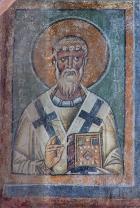
Holy Forty-Five Martyrs: Leontius, Maurice, Alexander, Sisinius and others
During the reign of the wicked Emperor Licinius, who ruled the eastern half of the Byzantine Empire, there was a great persecution of Christians. In Armenian Nicopolis, St. Leontius, with several of his friends, appeared before Lysius, the representative of Emperor Licinius and declared that they were Christians. "And where is your Christ?" Lysius asked. "Was He not crucified and did He not die?" To that St. Leontius replied: "Since you know that our Christ died, know also that He resurrected from the dead and ascended into heaven." After a lengthy discussion about the Faith, Lysius scourged them and threw them into prison and gave them neither food nor drink. Vlassina, a benevolent Christian woman brought them water and handed it to them through the window of the prison. An angel of God appeared to comfort and encourage them. When the time came for sentencing, two jailers and many others appeared before Lysius as converted Christians, totaling forty-five in number. The judge sentenced all of them to death but in this manner: first, that their arms and feet be severed with an axe and then they be thrown into the fire. This horrible two-fold punishment was carried out and the souls of the holy martyrs took flight to their Lord entering into eternal life. They honorably suffered and inherited the Kingdom in the year 319 A.D.
Venerable Anthony of the Kievan Caves
Anthony was the founder and father of monasticism in Russia. He was born in the small town of Chernigov and, at an early age, left his home and went to Athos, the Holy Mountain, where he was tonsured a monk and lived a life of asceticism in the Monastery Esfigmenou. In obedience to a heavenly appearance, the abbot sent Anthony to Russia to establish monasticism. Anthony chose a cave near Kiev. When those who were desirous of a monastic life gathered around him, he then appointed Theodosius as abbot and he remained in the cave as a Silentary. By the blessing of God, the monastery increased and became the parent-monastery of Russian monasticism. Anthony endured much evil both from men and demons but he conquered all by his humbleness. He possessed the great gift of discerning thoughts and the future and healed the sick. He presented himself to the Lord in the year 1073 A.D. at the age of ninety, leaving his spiritual nursery to bring beneficial fruits to the Orthodox people of Russia throughout the ages.
The Translation of the Honorable Vesture of Our Lord Jesus Christ
At the time of the suffering of our Lord Jesus for mankind, there was to be found among the ranks of the Roman army in Jerusalem a Georgian named Elioz from the town of Mtskheta. His mother had heard of Christ and, in her heart, believed in Him. Seeing her son off to the army in Palestine, she counseled him not to do anything against Christ. When the Lord was nailed to the Cross, the sound of the hammer on Golgotha reached the ears of Elioz's mother in the town of Mtskheta. Hearing this sound, she cried out: "Woe is me because I did not die before this time. Death would have rescued me from this dreadful sound!" Saying this, she fell dead. Elioz, at that time, was beneath the Cross and with the other soldiers cast lots for the tunic (robe) of Christ. He won the vesture and brought it to Mtskheta and gave it as a gift to his sister Sidonia. She, having heard about the death of the Lord and that her brother was a participant of the shedding of innocent blood, fell dead holding the tunic of the Lord firmly in her hands and no one was able to tear it away but were compelled to bury the tunic with her. A cedar tree sprouted from her grave from which poured forth a sweet-smelling healing myrrh. In time, the cedar tree fell and the place was forgotten. Following her prayer, St. Nina, found this place with the help of a pillar of fire. The baptized Emperor Mirian erected a church there dedicating it to the Holy Apostles. In the year 1625 A.D., the Shah Abbas took this tunic and sent it to Moscow as a gift to Prince Michael Feodorovitch and Patriarch Philaret. This tunic was placed in the Cathedral Church of the Dormition (Assumption) of the Blessed Virgin in Moscow.