






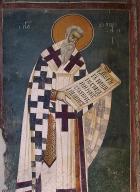


Holy Hieromartyr Babylas 9/17/2013
This great and wonderful man, if he could be called a man at all, as St John Chrysostom had said about him, was a hierarch in Antioch at the time of the blasphemous Emperor Numerian. Numerian made peace with a barbarian king that was much nobler and much more peace loving than him. As a token of his true desire for long-lasting peace, the barbarian king gave his younger son on the court of Emperor Numerian to be educated there. One day, Numerian with his own hands strangled this innocent boy and offered him as a sacrifice to the idols. Still inflamed from the crime and the innocent blood, this villain with the crown on his head went to the Christian temple to see what was happening there. St Babylas was praying together with the people, and heard that the Emperor was coming with his company and wanted to enter the church. Babylas interrupted the service, went out, in front of the church, and told the Emperor that he could not enter the holy temple where the one true God was praised. In a sermon, referring to Babylas, John Chrysostom said: "Whom else should fear he that with such power addressed the Emperor?... With that he taught the emperors not to spread their power more than the measure given to them by God; he showed the priests how should they benefit from the power given to them." Embarrassed, the Emperor left, but he devised a revenge. The next day, the Emperor summoned Babylas and started reproaching him and persuading him to offer sacrifice to the idols, which the Saint, certainly, irrevocably refused. Then the Emperor had him chained and thrown into prison. The Emperor had also tortured the three children: Urban, twelve years of age, Pridilian, nine and Epolonius seven years of age. Babylas was a spiritual father and teacher of these children and they were with him at all times because of their love for him. They were sons of a devout Christian called Christodula, who also suffered for Christ. The Emperor at first lined them up, and each child received as many blows with a rod as his years of age, then cast them into prison, finally to be beheaded all the three of them. Babylas, in chains, witnessed the tortures of the children and was encouraging them, and then himself laid his honourable head under the sword. The Christians buried him in chains, according to the pledge he had left before he died, in the same tomb with the three beautiful youths. Their holy souls flew to the heavenly dwellings and their miracle-working relics remained for the benefit of the faithful, to bear witness to their bravery in faith. They suffered about year 250 A.D.
